
Samson, Alabama residents found themselves without water on Nov. 6, 2023 as the
Samson Utilities Department diligently worked to resolve a water issue. The following
day, although the department had restored running water to the town, they continued in
their efforts after pinpointing the issues on S. Johnson St. It was during this time utility
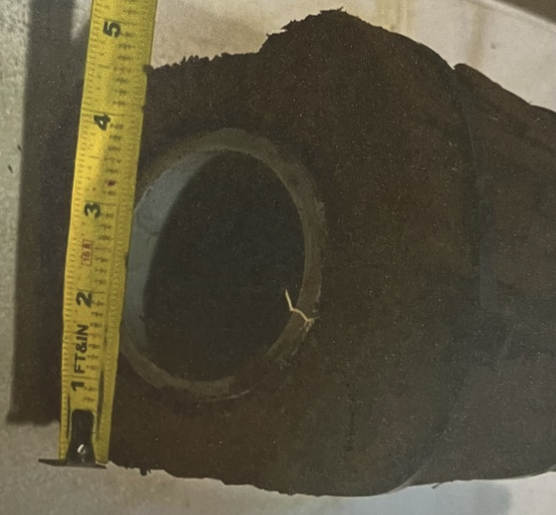
workers made an interesting discovery – a square wooden sewer pipe measuring
approximately 4.5 by 4.5 inches, with a 3-inch hole that would fit a pipe in the center.
Research revealed that the only other known example of such a pipe found in recent
years in the United States was discovered in Panama City, Fl., documented by the Bay
County Historical Society, in 2020.
According to an article by the society, these pipes were coated with creosote and made of
pine. The pipe in Panama City was labeled as “Creopine Atlanta,” indicating its origin
from the Southern Wood Preserving Co., which had facilities in East Point, Georgia, and
Chattanooga, Tennessee.
Research shows that wooden pipes have a long history dating back to ancient times.
Wood was used for water pipes in 16th and 17th century Europe, and in 18th and 19th
century Canada and the United States.
In the late 1800s, wood piping was machined to create smooth-bore, uniform-
circumference piping that could handle flows up to 60 psi, according to MSW Magazine.
The first wood stave pipe in New York for a water works system was built in Rochester,
New York between 1867 and 1870, bringing water from a lake 16 miles distant through a
pipe.
Despite their extensive use, wooden pipes did present some problems. They tended to
attract insects and rot over time. By the 1970s, all wooden pipes were being replaced by
PVC pipe for water supply and ABS pipe for drain-waste-vent applications.
Water Environment Federation cited that in Philadelphia, the city installed its first
wooden mains around 1800 as part of the city’s new water collection and distribution
system. In 1909, Philadelphia changed to modern piping. In Panama City, terracotta
pipes and cast-iron outlet pipes were introduced in 1912 and the project was completed
within two years. It can be speculated that Samson also transitioned to this type of
infrastructure around the same time frame. If this hypothesis proves correct, the wooden
sewer pipe uncovered by the Samson utilities department is well over a century old.